
'The West Asia or the Gulf crisis has shown that what we develop as national infrastructure when things are not as bad as they could be, we forget to plan for adversities.'

Reserve Bank of India Governor, Y V Reddy presented the Monetary and Credit Policy for 2006-07 on Tuesday.
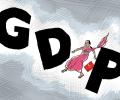
During the six-month period (April-September 2019), the Indian economy grew 4.8 per cent as against 7.5 per cent in the same period a year ago.
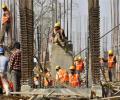
The EIU said in a report on Wednesday forecast that the real GDP grew by 1.6 per cent quarter-on-quarter in India, but noted that this uptick was largely owing to base effect.

India's online retail market concluded 2025 with electronic retail (e-retail) gross merchandise value (GMV) reaching $65-66 billion, a 19-21 per cent increase, according to a report by Bain & Company and Flipkart. This growth is significantly driven by GenZ shoppers and the rapid expansion of quick commerce, which has emerged as a global leader.

The country's real GDP growth in the first quarter will be better than the Reserve Bank's estimate of 8 per cent, economists said on Tuesday. Economists at the country's largest lender SBI pegged the growth at 8.3 per cent while domestic rating agency Icra estimated it to come even higher at 8.5 per cent. The Reserve Bank of India (RBI), which expects the GDP to grow at 6.5 per cent in FY24, has estimated a growth of 8 per cent in the April-June period.

Morgan Stanley believes that the factors responsible for the weak GDP growth include poor agricultural growth, weak investment trend, sluggish domestic market growth outlook and weakness in the service sector.

'India's output contraction in the previous year was among the worst in the world!'
The Confederation of Indian Industry has revised its projection of the GDP growth this fiscal from 6.5 per cent to seven per cent.
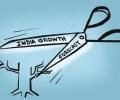
The Reserve Bank on Friday retained the real GDP growth projection at 9.5 per cent for 2021-22 as domestic economic activity has started normalising with the ebbing of the second wave of the virus and the phased reopening of the economy. In the June monetary policy, the RBI had lowered the growth projection for 2021-22 to 9.5 per cent from 10.5 per cent estimated earlier. Unveiling the bi-monthly monetary policy, RBI Governor Shaktikanta Dad said high-frequency indicators suggest that consumption (both private and government); investment; and external demand are all on the path of regaining traction.
With all-round upturn in economic cycle except in agriculture, Economic think tank NCAER has forecast India's GDP growth rate at 6.5 to 6.7 per cent for this fiscal.

The Indian rupee depreciated by 52 paise to settle at 93.35 against the US dollar, driven by failed US-Iran peace talks, surging crude oil prices due to a potential US blockade of Iranian ports, and a global flight to the greenback. This geopolitical uncertainty is also leading to foreign capital withdrawal from domestic equities.

There are vexing questions around the disconnect between Nifty returns and portfolio returns, between economic growth and earnings growth, and finally, between earnings growth and market returns, points out Debashis Basu.
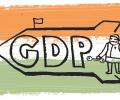
Sitharaman's Budget missed deficit target for the third year in a row, pushing shortfall to 3.8 per cent of GDP in the current fiscal as compared to 3.3 per cent previously planned.
Pakistan will achieve an 8.3 per cent growth rate, the highest GDP rate in its history, this year which will place the country in the top five fastest growing economies of Asia, Prime Minister Shaukat Aziz has said.

GDP growth during 2018-19 is estimated at 7 per cent as compared to 7.2 per cent in 2017-18.

Reserve Bank of India (RBI) Governor Sanjay Malhotra stated that preventing second-round effects of supply shocks, where inflation expectations rise due to prolonged disruptions, is the primary role of monetary policy. He also defended the RBI's foreign exchange market interventions, asserting it did not commit to an 'indefensible peg'.

Reserve Bank Governor Sanjay Malhotra on Friday said the key policy rates will remain at low levels for a long period and may go down even further.

'Congress needs a positive agenda rather than primarily picking up on two business houses.'
India's GDP is estimated to grow at 7.4 per cent in the financial year 2022-23 with rising prices triggered by the Russia-Ukraine conflict posing as the biggest challenge to the global economic recovery, Ficci's Economic Outlook Survey released on Sunday said. According to the survey, the Reserve Bank of India (RBI) is likely to start a rate hike cycle in the second half of 2022, while a repo rate hike of 50-75 bps is expected by the end of the current fiscal. The RBI is expected to continue supporting the ongoing economic recovery by keeping the repo rate unchanged in its April policy review, the survey said.
The Reserve Bank on Thursday said that the overall stance of its monetary policy for this fiscal would continue to accord a high-priority to price and financial markets stability and well-anchored inflation expectations.
Agriculture and allied activities are likely to grow at 5.4 per cent in 2010-11, compared to just 0.4 per cent in 2009-10, according to Advance Estimates released by the Central Statistical Organisation on Monday.

India, the world's fourth largest economy, is set to maintain the 'goldilocks' phase with tailwinds of good growth, low inflation and robust banking performance as well as reform initiatives poised to sustain the economic pace witnessed during 2025.
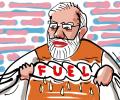
Following through announcements with enforcement of measures is key, as a run through recent Indian economic history shows, points out A K Bhattacharya.
Fitch Ratings on Thursday slashed India's GDP growth projection for FY23 to 7 per cent, saying the economy is expected to slow against the backdrop of global economy, elevated inflation and high interest rate. In June, it had forecast 7.8 per cent growth for India. "We expect the economy to slow given the global economic backdrop, elevated inflation and tighter monetary policy. "We now expect the economy to grow 7 per cent in the financial year to end-March 2023 (FY23) from 7.8 per cent previously, with FY24 also slowing to 6.7 per cent from 7.4 per cent before," Fitch said in its September edition of the Global Economic Outlook.
The Centre for Monitoring Indian Economy (CMIE) has lowered its growth forecast to 6 per cent, from 6.2 per cent projected earlier, for this fiscal, owing to the delay in recovery in industrial sector and the fall in mining, manufacturing and construction segments.

India's real gross domestic product (GDP) is likely to grow at 7.5 per cent in FY26 and moderate to 7 per cent in the subsequent fiscal year, a domestic rating agency said on Wednesday.

S&P also cut China?s GDP growth forecast to 7.5%t and that of rest of Asia.
Forecasting 7.2 per cent GDP growth for the current fiscal, industry chamber CII on Tuesday stressed on sustainable development for alleviating poverty and employment generation in the country.

Trade deals ease risks for Indian equities, but weak demand and stretched valuations raise questions over whether optimism -- especially in smallcaps -- can turn into a sustained bull run, points out Debashis Basu.
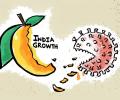
The Reserve Bank on Wednesday retained the GDP growth forecast at 9.5 per cent for the current fiscal but cautioned that the economic recovery is not yet strong enough to be self-sustaining and durable.

West Bengal Governor RN Ravi has called for collective efforts to restore the state's past glory, highlighting concerns over economic and educational indicators. His remarks coincided with Chief Minister Mamata Banerjee criticising him for allegedly 'abusing' her instead of extending New Year greetings.

Benchmark equity indices Sensex and Nifty rebounded on Thursday after three sessions of losses, tracking gains in global markets after US President Donald Trump struck a conciliatory tone on Greenland. In a volatile session, the 30-share BSE Sensex climbed 397.74 points, or 0.49 per cent, to close at 82,307.37.

India's services sector growth rose to a two-month high of 58.5 in January, on faster expansion in new business intake and output, prompting service providers to hire additional staff, a monthly survey said on Wednesday.

If this turns into reality, India's gross domestic product (GDP) growth will be the lowest since 2012-13, which could severely hit job creation and income growth in the near term.

India's urban areas are projected to contribute 70 per cent of gross domestic product in 2025-26, up from 45 per cent in the 1990s, according to a report by Dun & Bradstreet.
India's gross domestic product (GDP) growth during 2006-07 is estimated at 9.2 per cent as compared to 9 per cent during the previous year, advanced estimates of national income released by the Central Statistical Organisation say.

'At the first sign of real trouble, that money will move. There will be a run.'
